





An Independent, Data-Driven Approach to Local Media Geography
CLICK HERE FOR MORE ON THE L2 METHODOLOGY
CLICK HERE TO GET AN L2 DATAMAPPING ACCOUNT
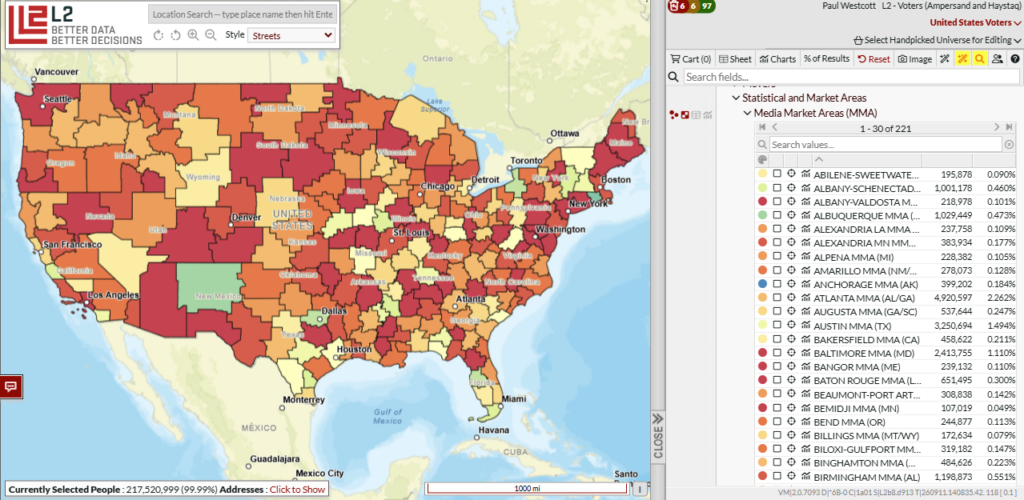
L2 Media Market Areas (MMAs) are now live in L2 DataMapping, providing clients with a new way to build audiences and analyze voter and consumer data across local media markets.
Advertising and communications campaigns often need to operate across practical regional markets rather than evaluate every county, city or ZIP Code individually. L2 developed MMAs as an independently constructed and transparent framework for organizing the United States into these markets.
Every U.S. county or county-equivalent is assigned to one L2 Media Market Area. These assignments are based on five factors:
- Broadcast coverage — 50%: Publicly available FCC data showing the television stations and predicted coverage serving each county.
- Commuting relationships — 20%: U.S. Census Bureau data measuring where residents live and work.
- Metropolitan relationships — 12%: Federal definitions of metropolitan, micropolitan and combined statistical areas.
- Geographic distance — 10%: The distance between a county’s population center and nearby media centers.
- Geographic continuity — 8%: The county’s relationship to surrounding counties, helping create practical and geographically coherent markets.
Broadcast coverage receives the greatest weight because MMAs are fundamentally intended to represent media markets. The additional factors help distinguish between competing markets, particularly in suburban, exurban and boundary areas where television coverage may overlap.
Independently Developed by L2
MMAs are L2’s own market geography. They are not Nielsen DMAs and are not intended to reproduce Nielsen’s proprietary boundaries.
Instead, L2’s methodology begins with publicly available information from sources including the Federal Communications Commission, U.S. Census Bureau and Office of Management and Budget. It asks a straightforward question: Based on broadcast coverage, economic relationships, metropolitan connections and geography, which media center is each county most closely associated with?
L2 also tests the stability of county assignments and identifies ambiguous boundary areas for additional review. This provides quality control while ensuring that unusual assignment decisions can be documented and explained.
Connecting Markets to Audience Intelligence
Creating the boundaries is only the beginning. Because MMAs are integrated directly with L2’s national voter and consumer databases, clients can use them to build audiences and compare markets across hundreds of characteristics, including:
- Age and household composition
- Income, education and homeownership
- Voter registration and political characteristics
- Consumer interests and behaviors
- Other demographic and socioeconomic attributes
This allows clients to look beyond the overall size of a market and identify where the audiences they care about are most highly concentrated.
L2 Media Market Areas are now available in L2 DataMapping. Log in today to begin exploring the new markets and building audiences within them.