





If you don't already have an L2 DataMapping account email us at info@L2-data.com or contact us HERE for a free trial
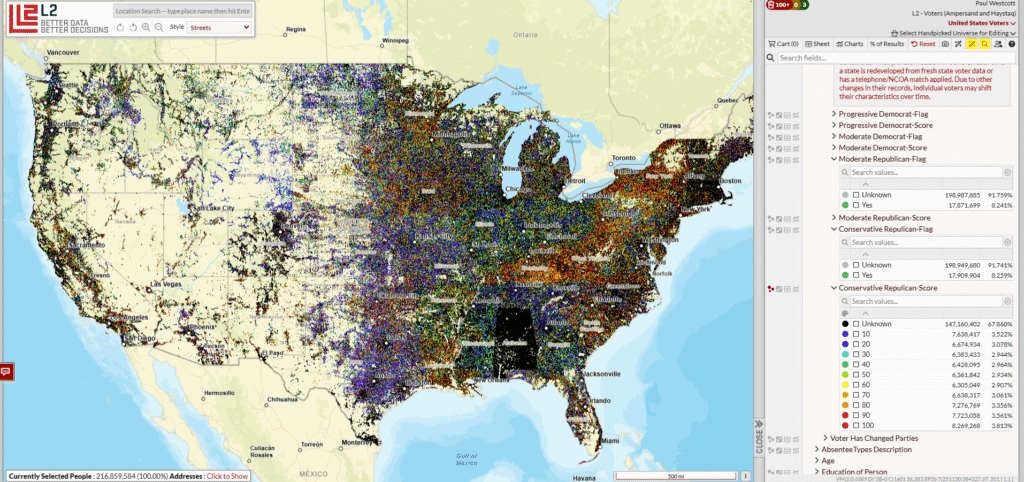
The L2 Partisanship Models are a suite of enhanced political-segmentation tools built using a hybrid methodology that blends large-sample nationwide survey responses, historical voting behavior, and demographic and consumer-based modeling inputs. These fields are not normalized by state—meaning a voter flagged as a Progressive Democrat is more progressive relative to all Democrats nationally, and a voter flagged as a Conservative Republican is more conservative relative to all Republicans nationally. Each model assigns both a binary Flag (indicating strong alignment) and a continuous Score, expressed in deciles from 10 to 100.
A score of 10 represents voters in the lowest decile (0–10th percentile),
20 represents the 10–19th percentile,
30 the 20–29th percentile,
…
and 100 represents the top decile (90–99th percentile).
These deciles reflect the likelihood that a voter matches the characteristic of a model, not an opposite ideology. For example, a Democrat in the 10th decile for the Progressive Democrat model is simply least likely to be progressive, not conservative. Likewise, a Republican in the lowest decile of the Conservative Republican model is not coded as liberal. Flags are assigned to voters in the top three deciles—80, 90, and 100—indicating a 70%+ statistical likelihood of fitting that ideological profile. Users seeking even higher confidence may select only voters with a score of 100, representing a 90–100% likelihood.
These models should be interpreted as statistically validated propensity indicators, not certainties. Individual voters may shift across deciles as new behavior, survey data, and voter file updates are incorporated. Scores and flags are recalculated each time L2 refreshes a state voter file.
Model Descriptions
Conservative Republican (Flag & Score)
Classifies individuals most aligned with conservative Republican ideology.
Key drivers: Large-sample survey correlations tied to GOP primary history, conservative issue alignment, and demographics typical of right-leaning households.
Moderate Republican (Flag & Score)
Identifies Republicans with more centrist or mixed policy preferences.
Key drivers: Survey responses reflecting mixed-issue views, suburban profiles, and occasional GOP primary participation.
Moderate Democrat (Flag & Score)
Classifies Democratic-leaning voters with centrist or blended ideological tendencies.
Key drivers: Survey alignment with moderate Democratic positions, Democratic general-election participation, and suburban/affluent demographic indicators.
Progressive Democrat (Flag & Score)
Identifies strongly progressive Democratic voters.
Key drivers: Progressive survey alignment, younger and urban demographics, and high political-engagement patterns.
Model Availability
L2’s ideological Flags and Scores are fully integrated across all L2 delivery environments:
- L2 DataMapping – searchable, mappable, and available for granular universe building
- LiveRamp – ready for activation, onboarding, and audience creation
- Snowflake – accessible in analytic environments and clean rooms
- Secure FTP flat files – delivered as part of L2’s complete voter-file taxonomy for database ingestion
Summary
The L2 Partisanship Models provide a high-resolution, frequently updated framework for understanding ideological alignment at individual and geographic scales. Built from the intersection of survey response data, behavioral signals, and demographic modeling, these Flags and Scores offer a statistically grounded, flexible toolset for targeting, analysis, and forecasting—while reflecting the reality that all modeling represents a “best-guess” estimate rather than a definitive classification.